
2026 is a game changer for solar energy as the U.S. accelerates its transition toward a sustainable future. Because of skyrocketing energy bills, persistent inflation, and increasingly frequent long power outages.
- Published On: August 06, 2026
Solar Panels and Home Insurance: What Every Homeowner Needs to Know Before Going Solar
Over 6 million U.S. households now have solar panels on their roofs or backyards, and the trend is booming every year as electricity costs and power outages are becoming a new norm. There is one important question that often comes up about solar panels and home insurance. Most first-time solar users are unaware of how solar panels affect home insurance until the problem becomes serious.
The truth is that solar panels and home insurance are more connected than most homeowners realize, and skipping this step can leave you underinsured for a system that costs you thousands of dollars in future. This guide explains how homeowners’ insurance works with solar panels, what damages are typically covered, how premiums may change, and what you should ask your insurance provider before making the switch to clean energy.
Why do you need home insurance with solar?
Installation of solar panels is not just a home improvement but a lifetime investment as the residential solar panels’ lifespan is up to 25 to 30 years. As residential solar installation is the most valuable asset of your house, insuring them against damages is as important as insuring your roof or foundation.
Most homeowners think that their installer’s warranties cover all damages for life. While manufacturers often offer equipment warranties and installers may provide workmanship warranties, neither replaces homeowners’ insurance. Warranties do not usually protect your solar panels from hail, storms, fire, falling branches or even theft. Knowing the basics about solar home insurance can help you save your investment.
Check Your Solar Savings with our Smart Solar Calculator!
Start with a free tailored solar quote, compare brands and financing options, and explore your potential with zero obligation.
How homeowners’ insurance works?
Typically, a home insurance policy provides coverage for different parts of your property or potential liabilities. Understanding those will enable you to get a better grasp of how their solar panels can fit in a policy and whether additional solar insurance is necessary.
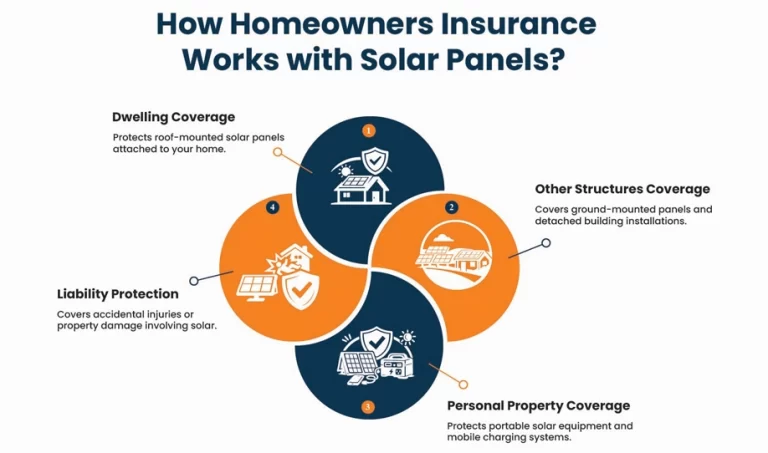
Dwelling Coverage
As the name suggests, dwelling coverage provides protection for the actual building on your property, including its permanently attached components such as the roof, walls, foundation, any attached garages, and electrical installations. Roof-mounted solar panels will fall under the category of a dwelling since they are attached to it permanently. Thus, in case your solar panels have been damaged in the event of fire, windstorm, hailstorm, or even falling trees, they will most likely be covered under your dwelling coverage within your homeowner’s insurance policy. However, homeowners should still notify their insurer after installation to ensure the home’s replacement value is updated to include the cost of the solar system.
Coverage for Other Structures
When solar panels are placed independently from the house, whether in ground-mounted solar systems or on any detached buildings, like a garage or workshop, they may fall into the “Other Structures” category within the homeowners insurance policy. As a rule, such coverage concerns those structures which do not belong to the primary residence. Since the limits of coverage for other structures are usually lower than those for the primary dwelling. You need to check about the policy terms in this case. If the cost of your ground-mounted solar system exceeds your coverage limit, you may have to increase the limits of the coverage to be protected.
Personal Property Coverage
Not all solar-related equipment is considered part of your home’s structure. Solar portable devices, such as solar generators or foldable panels for camping, are regarded as personal property in most cases. There may be different limits and deductibles associated with the insurance coverage for personal property, and homeowners need to confirm that their expensive portable solar panels fall under the personal property insurance coverage plan.
Liability Insurance Coverage
This type of insurance helps cover homeowners in case they become liable for any injuries or property damage that involves another person. Although solar panels do not increase the liability risk, there may be some cases when such insurance coverage might prove helpful. For instance, if solar panels detached from your roof due to severe storms or wind damage and caused any harm to your neighbor’s property, then liability insurance coverage can help cover these costs. Similarly, there might be an accident when some maintenance work is being carried out on your solar panels; in such a situation also, liability insurance may prove beneficial.
Do solar panels affect home insurance premiums?
Yes, but the change is usually minimal. Solar panels increase the value of your house, while the insurance rates depend on the cost of rebuilding your home, not its market value. If you have enough margin in the coverage limit of your current policy to compensate for the increase in value of your home, then your insurance rate may not change at all. If not, then the insurer will most probably suggest that you increase the coverage limit and it will be the reason for increased insurance rates, not solar panels.
Various factors determine where in the range, you’ll end up. A larger and expensive solar system will increase the replacement cost of your house by more, making the premium adjustment automatically higher. Location is another factor; houses located in regions that are prone to hailstorms, wildfires, or hurricanes are usually subjected to greater premium adjustments as compared to those in regions with milder weather conditions. Installation method is another critical consideration because the installation of roof mounted panels is always less costly when it comes to insurance. Lastly, different insurers price risks differently like some may consider solar paneling as a safer addition to your house than others.
Are solar panels covered under a standard homeowner’s policy?
In most cases, yes. Roof-mounted solar panels are treated as a permanent part of your home, the same way a chimney, skylight, or built-in HVAC system is. That means they typically fall under your dwelling coverage, which also protects your roof and structural components.
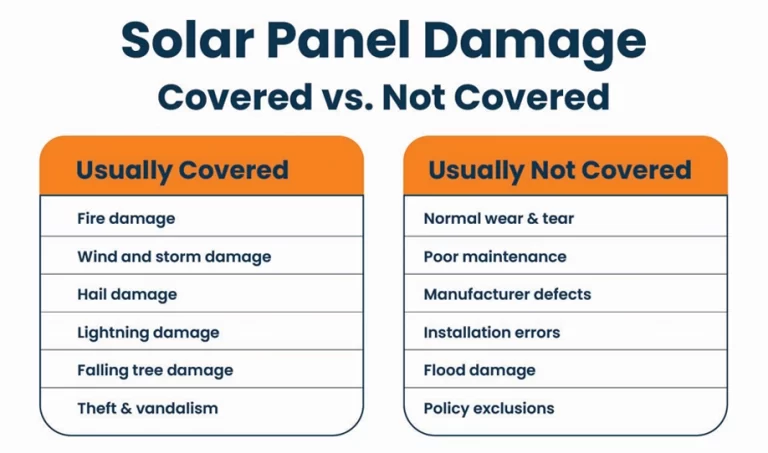
Ground-mounted or detached solar arrays work differently. Because they’re not physically attached to the house, they usually fall under other structures’ coverage instead, the same category as a detached garage or fence. This matters because other structures’ coverage is often capped at around 10% of your dwelling limit, which may not be enough to fully replace a large ground-mounted system.
How solar battery storage affects your home insurance?
Since many homeowners opt for solar battery storage systems, it is important for you to understand how they impact your home insurance. Your property’s replacement cost increases with the installation of battery storage as your property will now have:
- Batteries
- Backup electrical appliances
- Inverters
- Solar battery monitoring systems
- More wiring
Most insurers offer coverage for permanently installed batteries as part of the home’s electrical system. But in certain cases, you have to inform your insurer once your solar batteries are installed. Solar batteries must be installed by a certified installer as per the guidelines of your NEC electrical code 2023. This not only helps keep you safe but also avoids any claims disputes. The insurance company needs to know when you make any major changes to the structure of your home. Not informing your insurer could limit your payouts in case of any problems.
Important Insurance Questions to Ask Before You Go Solar
Besides the basic considerations of coverage and premium rates, there are several questions that are commonly overlooked, and asking them ahead of time will keep your claim from being denied down the road.
- You should know if your home insurance policy provides coverage for any damages that might occur while installing solar panels. This is because accidents do happen sometimes and your installer’s liability insurance will only take care of its part of liability.
- There’s also the question of what will happen if you need to repair the roof after the installation of the panels is complete. Solar panels may require removing and reinstallation again and many insurance policies don’t cover the cost of such labor.
- In addition, you should find out if your insurer demands you to have a licensed installer for your solar installation to get insured. Some insurance companies simply refuse to make a payment if a certified installer wasn’t used.
- It is also good to find out whether owning solar panels impacts your liability insurance. Sometimes, there can appear some problems related with electrical installation in case of fires or malfunctions that can concern not only you but another person’s property too. Therefore, it will be more useful to find out about your insurer’s policy beforehand.
- Ask your insurer whether they provide any discounts on their policies for solar-powered or energy-efficient houses. It may be worth asking, since some insurance companies consider solar power as an improvement to their customers’ houses and provide some discounts for that.
Common Insurance Mistakes Homeowners Make
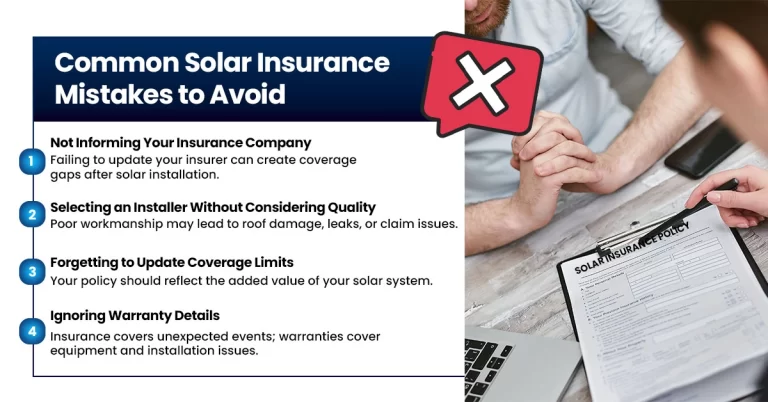
Homeowners often think that their existing insurance will cover solar installation. This is wrong. However, overlooking a few important steps can lead to coverage gaps, delayed claims, or unexpected out-of-pocket expenses. Here are some of the most common mistakes to avoid:
Why does professional solar installation matter?
Choosing a professional installer is just as important as selecting high-quality solar panels. A licensed and experienced installer ensures your system is designed and installed according to local building codes, electrical regulations, and manufacturer guidelines, reducing the risk of roof damage, electrical faults, or safety hazards. When you hire a professional installer, the chances of your system being damaged become low as well as any chances of electrical errors. Professional installation will not only make your system perform better but will also improve its efficiency and reliability. In terms of insurance, most insurance companies will prefer or may even insist on having documentation showing that your system has been professionally installed before settling any claim. Solar system installation experts will also give you proper documentation regarding your system’s installation including inspection reports and workmanship warranty.
Solar panels can serve as one of the worthiest investments for homeowners; not only will they reduce energy expenses but will increase the value of your home. However, to secure yourself from possible risks, the first thing you need to do is to make sure that your insurance covers the value of your solar panel installation.
The connection between solar panels and home insurance may seem rather difficult to comprehend at first; however, once the basic information on this matter becomes known, the following steps become very simple: find out what kind of installations your insurance covers, inform your insurance provider about the installation, and adjust the limit on your dwelling.
Solar SME is a certified solar installation company. We can help you with the best solar solution and home solar insurance options as well to protect your solar investment. You can get a FREE Estimate of your solar savings with our smart solar calculator!
Check Your Solar Savings with our Smart Solar Calculator!
Start with a free tailored solar quote, compare brands and financing options, and explore your potential with zero obligation.
Related Articles:
Solar insurance gives homeowners extra assurance that the system they invested in will produce energy as expected. Here’s a guide to everything else it does.

Among the renewable energy sources, the most trending one is solar energy. But the question is, are solar panels worth it? Solar systems for homes are reliable systems.