Get Solar Qualified With Our Smart Calculator!

GET FREE ESTIMATE!

$0 Down, No Debt & No Payments for 12 Months, Power Up Smarter with New Solar Lease!

OBBBA & Solar ITC Safe Harbor in 2026:
What Every Developer Needs to Know?

The One Big Beautiful Bill Act (OBBBA) has turned the picture of the Investment Tax Credit (ITC) Safe Harbor for commercial and industrial solar developers. On the 15th of August, 2025, the U.S. Treasury Department and the Internal Revenue Service (IRS) issued their Notice 2025-42 in response to the directive issued by President Trump. This notice guides the “begin construction” of the solar investment tax credit (ITC). Traditionally, to lock in 30% Investment Tax Credit, there was a 5% spend rule. However, the recent modifications to the One Big Beautiful Bill Act (OBBBA) are tightening the rules surrounding the tax credit’s eligibility and the tax credit time frame. This is a huge shift in the process for solar developers, which has serious implications for voilating rules. 

Solar ITC Safe Harbor

This guide assists solar developers in the successful execution of the safe harbor rules for 2026. It also covers various aspects of the OBBBA updates and IRS construction requirements.

What is the solar safe harbor, and how has it historically worked?

For the solar industry, safe harboring means the regulations that provide a project with an opportunity to ensure that it qualifies for the Investment Tax Credit (ITC) by showing that construction began prior to a specific deadline. 

Historically, developers can meet this requirement in a few ways:
● The 5% rule, which generally requires incurring at least 5% of the total project costs
● The physical work test, focused on beginning of permanent work.

For many commercial solar projects, the 5% rule and safe harboring is closely related to equipment procurement. This means that by procuring qualifying solar equipment prior to the deadlines, projects can ensure that construction begins. Even though the project itself would not be in operation until a later time. This has given projects leeway to begin construction with earlier versions of the regulations.

What changed under OBBBA and why 2026 is different?

To achieve safe harbor and qualify for ITC, it is imperative that project developers have a step-by-step approach. This will include coordination in construction start, documentation, continuity, and compliance. The following steps can achieve effective project execution. 

As commercial solar projects approach 2026, safe harboring strategies are under more scrutiny and execution risk. It is no longer enough to rely only on early equipment purchases despite the 5% rule, and physical work tests are still part of IRS rules.

Due to stricter enforcement of continuity criteria, projects must show continuous, quantified progress after a stated construction start date. A project’s safe harbor status can become weak due to protracted delays between procurement and activity.

At the same time, new supply-chain factors have been added by changing FEOC guidelines. Project risk assessments now include equipment sourcing, vendor transparency, and documentation more directly. Especially for teams thinking about advanced procurement as part of a safe harbor plan.

Overall, these modifications indicate that safe harboring in 2026 will be more about coordinating construction activities, procurement scheduling, documentation, and project execution than it will be about fulfilling a single cost criterion. 

What deadlines must solar developers track in 2026?

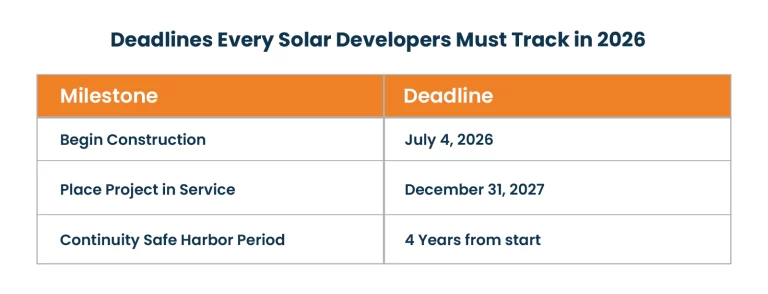
It is also essential to track important deadlines to maintain the eligibility of the solar projects under the ITC provisions of the revised OBBBA guidelines. Failure to meet one of the deadlines can affect the financial viability of the project in a major way. It is essential to be in line with the deadlines to reap the tax benefits. 

Safe Harbor Deadlines

What qualifies as “Beginning Construction” in 2026?

The IRS identifies that there are two basic ways of establishing that construction on a solar project has commenced, but with the new regulations in 2026, both have to be more carefully interpreted and implemented. 

Physical Work Test

This includes activities such as site grading, pouring foundations, or putting up mounting structures. It also includes the manufacture of components that are specifically designed for the project but not obtained from pre-existing inventory. It also includes making contracts for work that represents significant physical progress. 

Limited 5% Spend Test

The applicability of the 5% Spend Test is limited to specific conditions, which are mostly related to small-scale or grandfathering cases. To satisfy this, at least 5% of the total project cost must be spent before the deadline of July 5, 2026. However, in comparison to previous years, the applicability of the 5% Spend Test has become more restricted and less predictable. 

What Does Not Qualify as Construction?

It is equally important to understand what is not considered the start of the construction process. Activities related to obtaining permits, performing engineering activities, developing system designs, or general pre-construction activities are not considered the start of the construction process according to the IRS. 

What are the practical steps to ensure safe harbor compliance?

Safe harbor compliance for the year 2026 demands a concerted and timely approach. The developers need to strategically execute the construction activities to ensure ITC eligibility, along with safe compliance. However, this demands a timely and concerted approach. 

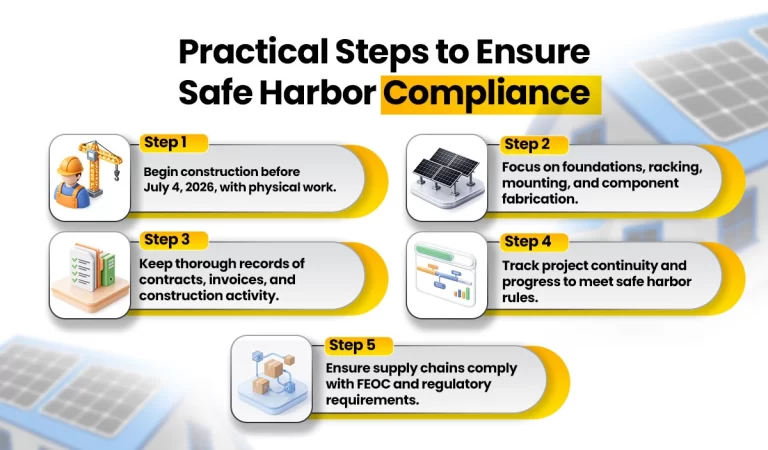
Practical Steps to Ensure Safe Harbor Compliance

Step 1:

The very first and most important factor for developers to consider for ITC eligibility is to start construction before July 4, 2026. It is imperative for developers to understand that this does not mean merely procuring equipment or signing contracts; it also involves ensuring that the equipment is properly maintained and utilized effectively. Instead, developers need to start activities in a manner that reflects actual construction. 

Step 2:

In the year 2026, the focus has clearly shifted towards the physical activities of building and constructing, as opposed to the financial thresholds. This includes activities related to the building of foundations, the installation of racking systems, solar mounting structures, and the fabrication of solar components. This is more indicative of the start of the project and is more in line with the IRS. 

Step 3:

Documentation is another key factor that comes into play when determining the start of the project and the compliance process. It is essential that the developers keep detailed records related to the project, which would be essential in substantiating the activities undertaken. 

Step 4:

Maintaining continuity is equally essential as it tracks the construction. Also, it is important to set project timelines accordingly to ensure the completion of the project within a 4-year safe harbor window. Moreover, the projects must be tracked, and accurate records of ongoing projects must be kept to ensure eligibility. 

Step 5:

With the added considerations of FEOC, supply chain compliance is now an essential aspect of safe harbor eligibility. It is essential to assess and evaluate the suppliers and strategies of supply chain management to ensure that all equipment and materials are in compliance with regulations and laws to enhance project eligibility. 

What are the risks of missing safe harbor requirements?

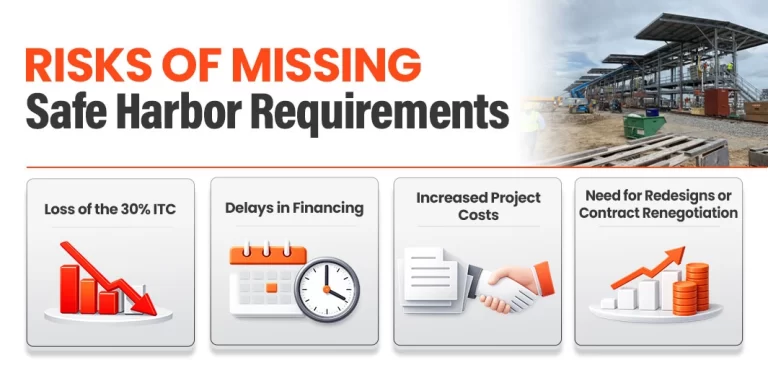
Missing safe harbor milestones can lead to: 

Risks of Missing Safe Harbor

Large commercial developers face heightened risk due to complex supply chains and longer construction timelines. 

In conclusion, OBBBA has made it more complex and important than ever for solar developers to comply with the safe harbor regulations in order to qualify for the federal ITC incentives. However, it is important for the developers to start early with the construction process and complete it with appropriate documentation. Furthermore, it is important to assess the equipment suppliers in order to comply with the FEOC regulations. 

Solar SME is a local commercial solar installer helping many businesses to switch to solar and ensure timely and top-notch solar installation service. You can estimate your commercial solar savings with our smart solar calculator.

Related Articles:

The U.S. solar market is shaped by state solar policies and Renewable Portfolio Standards (RPS). This guide explores how incentives, net metering changes, and local challenges impact solar deployment and emerging opportunities for homeowners and the clean energy industry.
For business owners, every minute of outage means loss and delay, making energy independence a major concern. That is where commercial solar comes in as a solution. This guide will help you understand the factors impacting cost and tips for less expenses.
In the U.S., frequent and long power outages are increasing, costing many businesses a loss of billions a day. One of the major reasons of suffering is grid reliance. Explore how Investing in commercial solar and battery backups is a smart solution for companies.

Scroll to Top