
- Published On: May 20, 2026
Solar Panels and Battery Backup: Why Every American Needs This Smartest Home Upgrade in 2026?
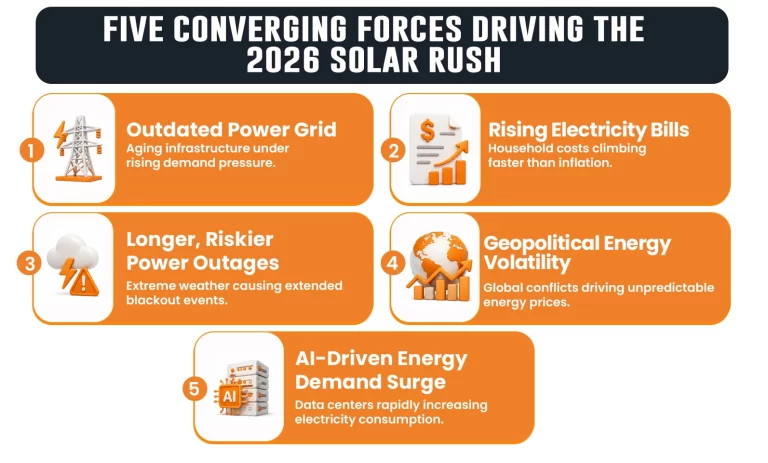
A seismic shift is taking place within American communities. The once- luxury status of residential solar panels is being replaced by the urgent need for a financially and safety-savvy choice. But the trend is not stopping with solar panels. Rather, it extends to the combination of solar power generation with backup batteries, with such speed that it astonishes even industry insiders. In other words, Americans are no longer chasing incentives. But are instead choosing security in response to growing risks of their household energy supply. And it is indeed a risk, given rising electricity rates that rose to an unprecedented average price of 18.05 cents per kWh in 2026 (+5.4% from last year), increasing duration of power outages, geopolitical turmoil threatening energy security, and an increasingly outdated and burdened electrical grid straining under pressure to provide power for AI data centers.
This guide will explain the reasons behind the choice of thousands of American households . Also, we will explore how they can benefit from making this decision.
The Numbers Don't Lie: Demand for Solar and Batteries Set to Skyrocket in 2026
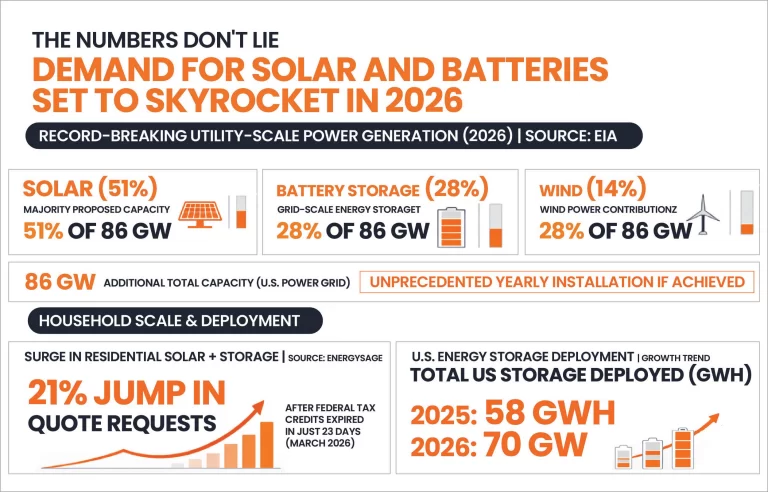
The figures emerging from 2026 have never been seen in the energy industry before. According to EIA, developers of power plants have plans to install 86 gigawatts of additional utility-scale generation capacity in the U.S. power grid during 2026, an unprecedented amount if achieved. Solar comprises 51% of the proposed capacity, with battery storage and wind accounting for 28% and 14%, respectively.
In addition, the situation looks no less remarkable on a household scale. According to Energysage, quote requests for solar-plus-storage systems surged 21% in just 23 days in March 2026, a staggering jump that happened after federal tax credits expired. Also, the U.S. will deploy 70 GWh of storage in 2026, as opposed to 58 GWh in 2025.
The Actual Reasons Behind Why Americans are So Flocking to Solar + Storage?
There’s a reason for this trend; it has everything to do with the increasing cost and uncertainty of utility power all over America. People are starting to understand that depending solely on their local power utility company is getting progressively more costly and less reliable.
Here’s why Americans are so flocking to solar + storage:
1. The Power Grid Is Outdated:
America’s grid system dates back to the middle part of the last century, with many areas having been in operation for decades past their intended design life. Rising electricity consumption caused by industry and tech usage is testing the limits of an already fragile grid, and climate events are making reliability increasingly uncertain.
Data centers consumed 4% of total U.S. electricity in 2025, and their energy demand will more than double by 2030. Investor-owned utilities project $1.1 trillion worth of expenditures from 2025 to 2029 on replacing aging electrical systems and you’ll be paying for every penny via your electricity bills.
2. Electricity Bills Are Rising Faster:
The average residential electricity bill climbed from $121 per month in 2021 to $156 in 2025, an increase of almost 30%. Electricity rates average 18.05 cents/kWh nationally in May 2026, but the rate is over double that figure for states such as California (33.75 cents/kWh), Massachusetts (31.51 cents/kWh), and Rhode Island (31.30 cents/kWh). While inflation has remained constant at 2.4%, energy services have seen a substantial boost, and electricity is driving up household costs significantly this year. This 5.4% increase in 2025-2026 follows two years of decline due to higher natural gas prices, a surge in electricity demand from data centers, and grid hardening expenditures shifted to consumers.
3. Power Outages Are Lasting Longer and Becoming More Risky:
A study in 2025 showed that 45% of Americans had at least one power outage in the first half of 2025 with roughly half the outages resulting from severe weather conditions. The duration of the longest outage reached 12.8 hours by mid-2025 compared to 8.1 hours in 2022. In the South, weather-induced power outages lasted an unbelievable 95.2 hours, which translates to about four days without power.
4. The Politics of Energy are Reflected in Your Power Bill:
An important point of contention in 2026 came in the form of the Strait of Hormuz, a critical waterway through which about one-fifth of the world’s oil passes. With tensions surrounding Iran, energy prices soared. The reality is that fossil fuels run many U.S. homes and these are sold in markets that are vulnerable to sudden geopolitical disruptions. Americans are realizing that they have exposure to geopolitics with every power bill, and renewable energy storage provides a hedge against this.
5. AI’s Explosive Demand for Power:
The explosive demand for AI-driven data centers necessitates huge, constant sources of energy, imposing fresh demands on the electrical supply infrastructure and driving up the cost of power. The forecasted growth rate in demand for energy from data centers is to grow by more than twice its current level by the year 2030.
Why Solar Without a Battery is Only Half the Solution?
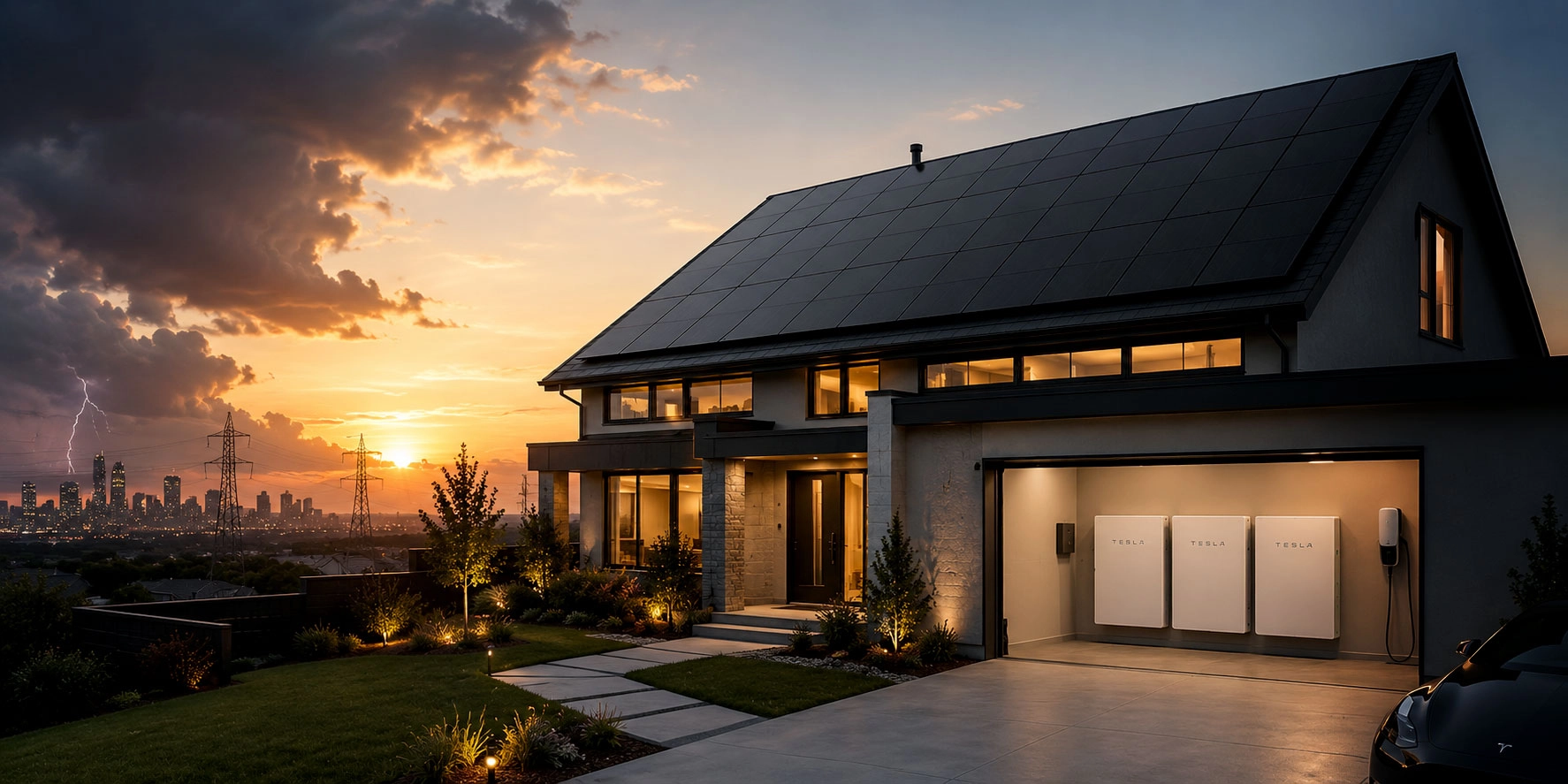
This is where many homeowners misunderstand their solar system. In reality, solar panels alone don’t do any good when you’re experiencing a power failure.
If your electricity stops working, your solar array must turn off due to legal requirements for grid tied systems. Without a battery backup, you’re no better off than the homeowner next door whose roof isn’t even covered with solar.
But by adding storage to your system, you gain:
- Capability of running independent from the grid
- Bills saved by discharging solar energy during peak pricing times
- No risk of sudden TOU pricing increases
Enrollment in Virtual Power Plant programs in which utilities pay you to discharge your solar batteries during emergency outages (Texas, Arizona, etc.)
Is Solar and Backup Storage Right for Your Home? Key Points to Consider
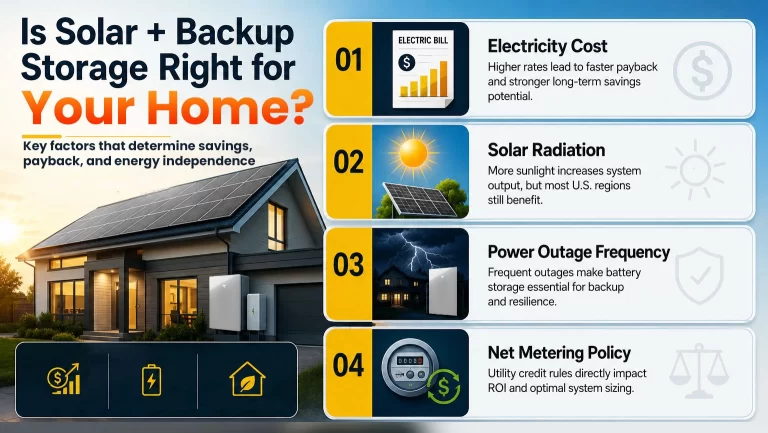
Not all houses are the same but almost all homes have the potential to benefit, given several critical considerations that directly affect savings, payback, and energy independence. These are the key variables to take into account when deciding whether solar plus storage is right for your needs:
Electricity cost: Higher rates accelerate the payback period and maximize long-term benefits. Although the payback at the national average is already favorable, and costs are steadily increasing.
Solar radiation: The Sun Belt (CA, AZ, TX, FL, NM) enjoys higher production levels by default, but even other, non-sunny states like New York, Illinois, and Massachusetts can reap great returns from optimized installations.
Power outages frequency: Several outages in the past couple of years? Living in hurricane-prone zones or wildfire areas? In these cases, battery storage is a matter of energy safety as well.
The net metering/net billing policy at your utility company: This will be key to determining how much benefit you can extract from any extra power produced by your panels and therefore how much battery capacity you need.
The entire conversation surrounding solar has taken a new turn. Previously, the focus was on the savings one could make in the next two decades. Nowadays, solar and battery backups are an investment that not only offers protection from the increasing cost of electricity, but one that will safeguard you against power outages resulting from the current state of the power grid where 1 in 6 Americans is behind on their payments. It’s becoming increasingly difficult for homeowners to overlook investing in solar energy due to the uncertainty that exists.
Solar SME is a trusted local solar installer near you, offering tailored solar with battery backup solutions for your needs. You can get a FREE Online Solar Estimate.
Related Articles:
The ongoing US-Iran conflict is causing major disruptions in global energy supply, pushing electricity and fuel costs higher. Learn how this impacts your home budget and how solar power, battery storage, and EV technology can help you reduce bills and stay protected.
The future of AI depends on resilient energy systems. Explore how solar photovoltaic systems combined with battery storage help data centers manage peak demand, lower emissions, enhance uptime, and strengthen ESG performance.
2026 is a game changer for solar energy as the U.S. accelerates its transition toward a sustainable future. Because of skyrocketing energy bills, persistent inflation, and increasingly frequent long power outages.