

Get Solar Qualified With Our Smart Calculator!

GET FREE ESTIMATE!

$0 Down, No Debt & No Payments for 12 Months, Power Up Smarter with New Solar Lease!

Bypassing the Grid: Why Big Technology Companies are Turning to On-Site Solar + Storage in 2026

The energy sector in 2026 is experiencing an unprecedented transformation due to the growing demand of Artificial Intelligence (AI) and an overloaded American electrical network. Centralized utility companies’ role in growth for Big Technology Companies has been phased out due to the rising power demand at data centers, which is predicted to grow to almost 9% of the total U.S. power demand in the current year. So, to protect themselves from changing wholesale rates, hyperscale’s such as Microsoft, Google, and Amazon have started “bypassing the grid” by installing On-Site Solar + Storage systems. Such systems provide companies with energy security, enable them to meet their goal of generating 24/7 carbon-free electricity. Also, this spare them from transmission constraints that can be addressed only after upgrading infrastructure and waiting 9 years to complete the process. 

On-Site Solar + Storage in 2026

Due to advanced solar battery chemistry, a profitable tax equity structure, and the pressing issue of “behind-the-meter” stability, on-site power generation became the preferred choice for technology companies in 2026. The following article will discuss the reasons for the transition. Also, we will focus on the role of PPAs and tax equity in financing commercial solar projects.

The Crisis of the American Grid: Why Tech Giants Can’t Wait

Right now, the American electrical grid faces a “perfect storm” situation. Also, the infrastructure is already around six decades old since it was mainly constructed in the 60s and 70s. The grid is not a trustworthy companion for Big Technology Companies. Moreover,  core reasons of big companies investing in on-Site Solar + Storage technologies include: 

1. Transmission Bottleneck and AI Boom:

Due to the boom in data centers powered by AI, there is a massive backlog in grid connection applications. Currently, in 2026, an average data center can expect a delay of 5 to 7 years for a high-voltage grid connection process. So, the company that builds on site will avoid all these inconveniences. 

2. Power Grid Vulnerability:

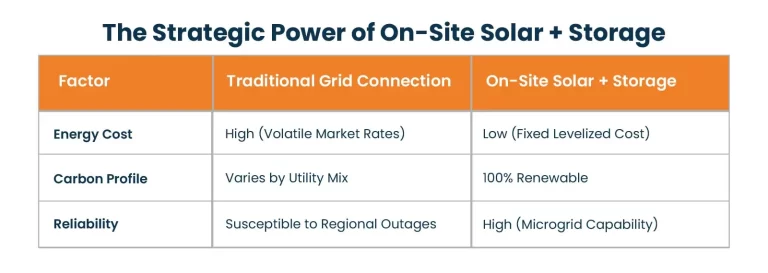
Extreme weather conditions happen frequently, which makes the American grid extremely unreliable. Also, with a constant threat from hackers, “downtime” is the last thing the CEO wants to think about. On-Site Solar + LDES provides independence during regional blackouts. 

The Strategic Power of On-Site Solar + Storage

The deployment of PV modules, along with a modern battery energy storage system (BESS), is the backbone of on-site energy independence. Also, by the end of 2026, this tech ecosystem will undergo significant changes. These upgrades will make it more ready for the needs of industrial plants and data centers. While lithium-ion battery technology prevails across the market, there is a rise of higher-capacity alternatives like iron-air and sodium-ion batteries with much higher capacities. Such solutions are especially suitable for ultra-long duration storage, as they accumulate power sufficient for at least 100 hours. It also proves to be an important factor because this makes extended periods without sunlight and in bad weather conditions less impactful for business continuity. Moreover, innovations in the field of grid-forming inverters give another strategic advantage for the on-site solar systems. It enables them to independently stabilize the frequency and voltage on site. 

The Strategic Power of On-Site Solar + Storage

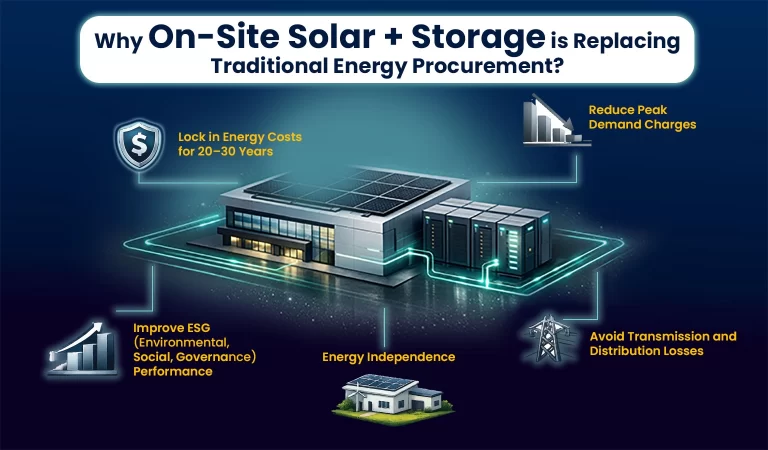
Why is On-Site Solar + Storage Replacing Traditional Energy Procurement?

Solar + storage is fundamentally disrupting the way that companies procure and manage electricity. Rather than relying strictly on their utilities, they are now producing their own energy to get control over costs and supply. Furthermore, some of the most common reasons are: 

On-Site Solar + Storage Replacing Traditional Energy

1. Energy Cost Stability for 20-30 Years:

With an on-site solar solution, companies are able to lock in electricity pricing for an extended period. Also, this setup protects them from rate increases by utilities and fuel price spikes. For companies like data centers and manufacturers, where the consumption is consistent and high, having predictable rates is important. 

2. Decreased Peak Demand Charges:

Many utility bills increase based on the highest level of energy used during specific times. Hence, solar batteries help reduce the peaks in electricity consumption and eliminate demand charges, which reduces utility bills. 

3. ESG (Environmental, Social & Governance) Improvements:

Using renewable energy sources at the company’s site helps achieve sustainability goals and respond to market expectations. Moreover, it positively influences the company’s image through the clearly visible transition to green energy sources.  

4. No Energy Loss from Transmission & Distribution:

Producing on-site electricity with solar means that there is no need to transmit this electricity over great distances, and consequently, the losses of energy in the process. 

5. Energy Independence:

With On-Site Solar + Storage, companies maximize energy independence, reducing their vulnerability to problems in external supply. 

How Commercial Solar Financing Makes On-Site Solar Accessible?

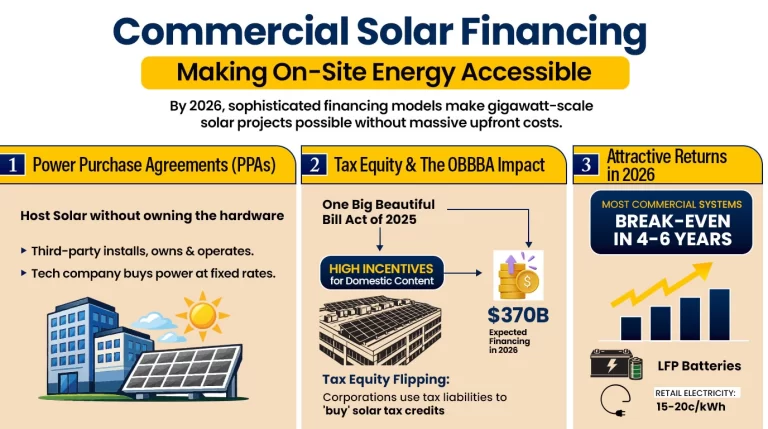
Without the commercial solar financing option, a company definitely requires a big investment like CAPEX for gigawatt capacity projects in 2026. The primary financing options for businesses include:

1. On-Site PPAs:

This option allows technology companies to install solar farms on-site without purchasing the panels themselves. Also, the project is financed by a separate entity, which owns the facility and sells the electricity produced to the company at reduced rates (lower than grid electricity) for a long-term period of 15-25 years. 

2. The Effects of Tax Incentives and OBBBA:

Although the new legislation enacted in 2025 called “One Big Beautiful Bill Act” (OBBBA) made many changes to the existing financial incentives, tax equity benefits are still a way to reduce the cost of commercial solar installation.
Tax equity funding is an important path through which solar projects can become economically feasible due to tax incentives. Under this arrangement, high-tax investors provide funding in return for the chance to claim such advantages as the ITC and accelerated depreciation. The total costs of the project are thereby greatly reduced for corporations undertaking solar plus storage projects. Not only does this minimize capital needs but it makes funding easier to obtain because of improved cash flows. This type of financing continues to be one of the foundations of renewable energy development in the United States, especially when it comes to corporate solar projects. 

What is behind-the-Meter energy infrastructure, and why is it growing in 2026?

Behind-the-meter energy infrastructure is a solar power plant connected to an energy storage within the consumer’s premise. The system generates, stores, and consumes energy within itself without delivering surplus energy to the grid. Also, Behind-the-Meter energy infrastructure will expand in 2026 as companies attempt to gain more control over energy cost, efficiency, and reliability. By producing power within the premises, saving excess energy in the battery, and consuming it immediately, businesses can limit their reliance on power suppliers. 

It also increases energy resilience, which is essential for tech companies, data centers and manufacturing plants that need constant power supply. Moreover, the business can enjoy various benefits such as reduced susceptibility to grid energy price fluctuations, minimal grid use fee, and enhanced energy reliability, making behind-the-meter energy infrastructure an attractive choice. 

The Road Ahead: 2026 and Beyond

The rise of big Technology Companies opting out of the grid represents a fundamental shift in the American energy economy. With the challenge of building transmission lines only getting more difficult and electricity consumption rising at an alarming rate, there’s reason to believe that the “Behind-the-Meter” phenomenon will continue to spread to sectors like heavy manufacturing and healthcare. Bypassing the grid is the ultimate insurance policy. When it comes to ensuring the machines that make our digital world possible, our data centers and artificial intelligence never run out of steam, nothing beats On-Site Solar + Storage in 2026 for Big Technology Companies. With advancements in solar and battery technologies, on-site energy generation can very well be the go-to approach for large-scale infrastructure. Solar SME is a commercial solar installer near you. We custom design solar and backup solutions according to your business energy needs. You can get a FREE online estimate with Solar SME’s smart solar calculator.

Related Articles:

The ongoing US-Iran conflict is causing major disruptions in global energy supply, pushing electricity and fuel costs higher. Learn how this impacts your home budget and how solar power, battery storage, and EV technology can help you reduce bills and stay protected.
OBBBA brings critical updates to Solar ITC Safe Harbor in 2026. Discover IRS construction requirements, new enforcement on continuity, and essential deadlines developers must meet to secure tax incentives and avoid costly project delays.
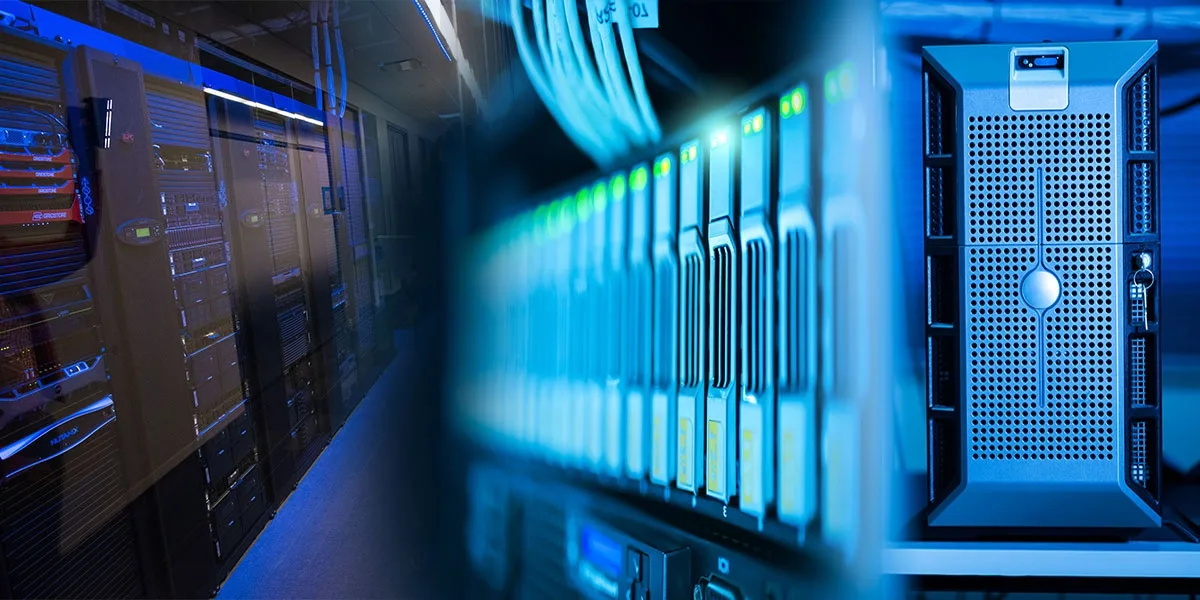
The future of AI depends on resilient energy systems. Explore how solar photovoltaic systems combined with battery storage help data centers manage peak demand, lower emissions, enhance uptime, and strengthen ESG performance.

Scroll to Top