Get Solar Qualified With Our Smart Calculator!

GET FREE ESTIMATE!

$0 Down, No Debt & No Payments for 12 Months, Power Up Smarter with New Solar Lease!

Is Your Area at Risk of Summer Blackouts in 2026? NERC's Assessment, El Niño & Heat Dome Threats

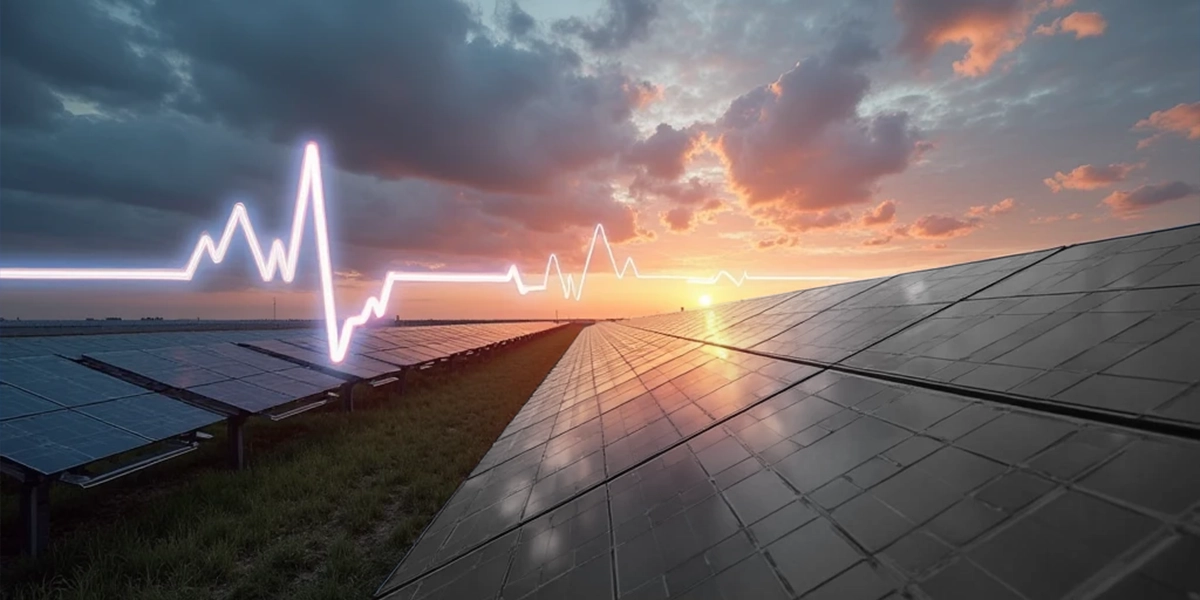
The American power grid is going through one of its toughest summers these years. There’s been a rise in electricity consumption due to long, hot summers causing increased air conditioning usage, increased use of electric vehicles, and power consumption from Ai data centers. According to NERC, the summer peak demand is up by over 11 GW compared to the projected values for 2025. Also, El Niño weather patterns are adding to these challenges by raising temperatures beyond normal throughout U.S. Along with the danger of heat domes, this scenario not only stresses the grid but as per research, this also reduces the efficiency of solar panels by 12% to 20% during the peak periods when the energy requirement is at its highest. 

El Niño & Heat Dome Threats

But for people looking for solutions, integrating solar panels with battery storage is the answer. A well sized solar system keeps your home running through power outages. Also, it saves you from being overly dependent on power grid, and lowers bills during peak pricing hours. In this article, you will find out which are the riskiest areas. Also, we will explore how hot weather and El Niño climate raise electricity bills. Moreover, we will discover how heat can affect the efficiency of solar panels. Furthermore, we will explain why battery storage may become one of the best ways to protect against power disruption.

What is revealed in NERC's 2026 Summer Reliability Assessment about Future Blackouts?

It would be wrong to say that NERC’s 2026 Summer Reliability Assessment provides just blackout warning. On the contrary, the report predicts that there will be enough resources to satisfy the peak of the summer consumption. It is an improvement by the addition of the new capacity, but there are some important caveats about it. John Moura, Director of Reliability Assessments at NERC, said in the webinar presentation of the report: “We have seen some improvements this year. And this certainly does not mean that overall grid reliability risk is over. 

Check Your Solar Savings with our Smart Solar Calculator!

Start with a free tailored solar quote, compare brands and financing options, and explore your potential with zero obligation. 

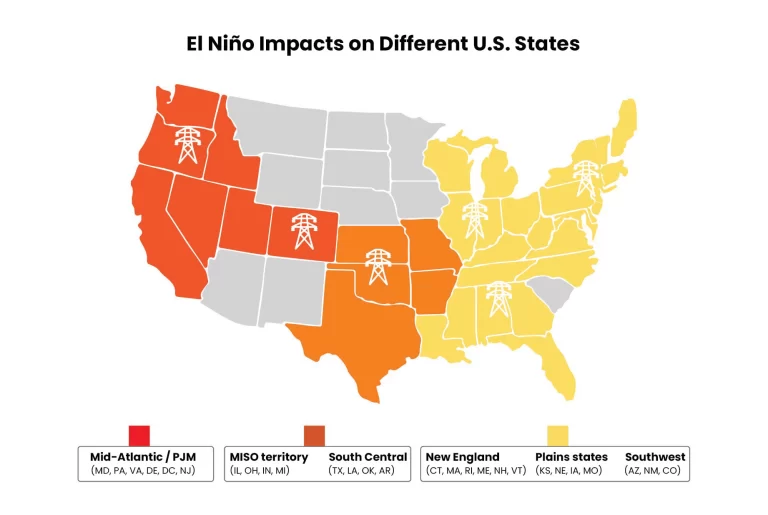
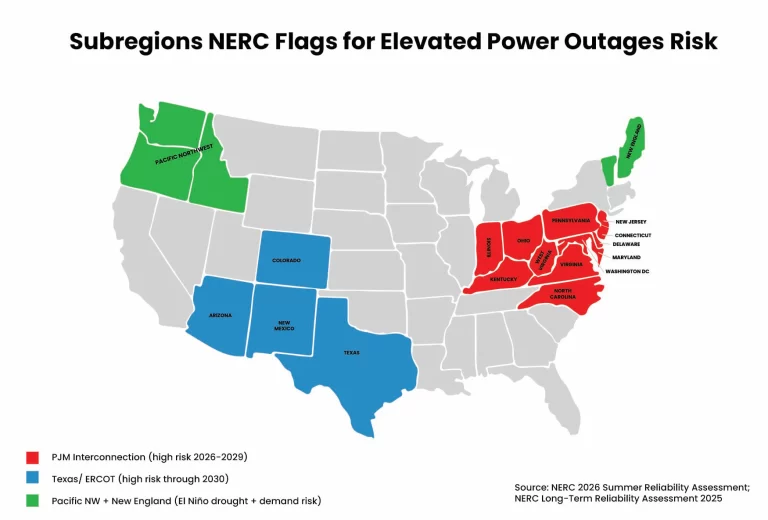
Subregions NERC Flags for Elevated Power Outages Risk

In the NERC’s report, there are three particular sub regions highlighted as being at high risk of supply shortage amid normal or extreme summers. 

Subregions NERC Flags for Elevated Power Outages Risk

The PJM Interconnection:

NERC identified PJM to be at high risk starting from 2026 up until 2029. The Available Reserve Margin (ARM) for summer in this region fell drastically, from 35.7% to 29.7% within just a year. It is due to increased power demands from AI data centers, electrification, and manufacturing. The expected peak summer demand for PJM is will increase from 154GW to 210 GW in 2035. This depicts that states covering by PJM like Maryland, Pennsylvania, Virginia, Kentucky, Delaware, North Carolina are all will face more energy challenges and power outages. 

Texas (ERCOT):

The Far West of Texas is also at risk during peak demand seasons with low wind generation and less solar power generation in the evenings. According to the NERC’s long-term forecast, the ERCOT could be at high risk till 2030. 

Pacific Northwest and New England:

Due to El Niño droughts, the Pacific Northwest, which gets 55% of its electricity from hydro, is at high risk. New England is also at risk due to rising demands and reduced energy supplies. 

What a heat dome does to the grid and your solar equipment?

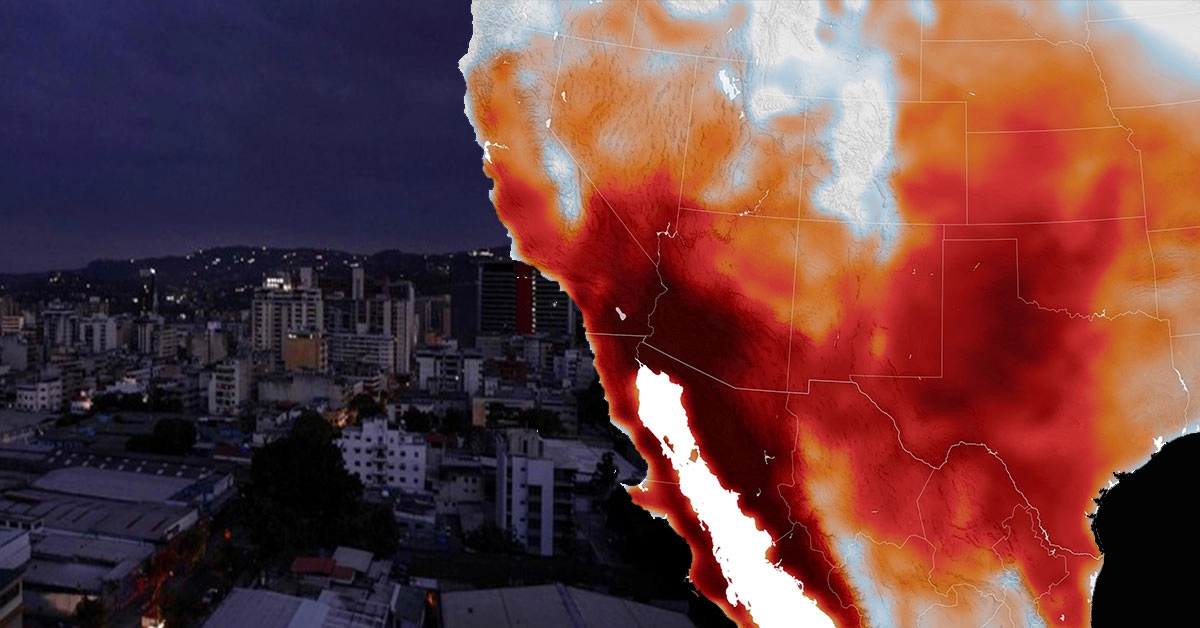
The term “heat dome” refers to a weather pattern where high pressure in the atmosphere traps warm air close to the surface. This leads to hindering cloud formation and resulting in rising temperatures. For the 2025 heat dome, grid operators in the data-center-populated region of Northern Virginia faced blackout challenges due to increased energy needs from AI infrastructures. 

How extreme heat impacts solar panels and equipment efficiency?

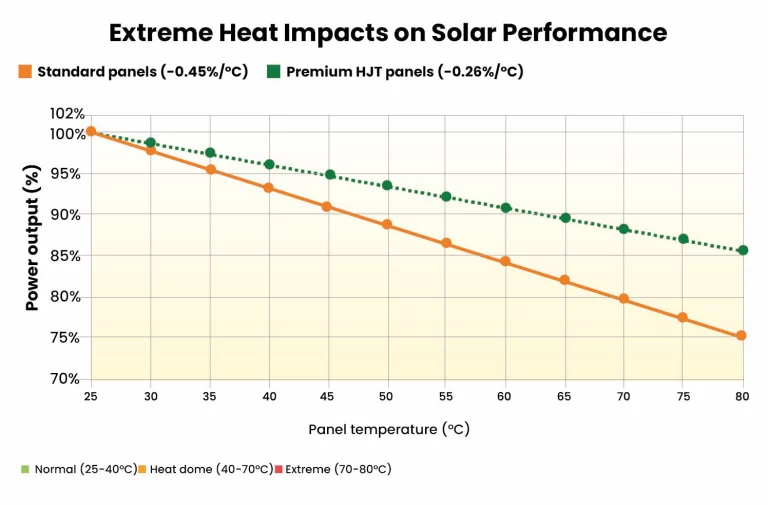
Many people believe that extreme summer weather automatically means more solar production. But it’s a common myth about solar output. In fact, solar panels generate electricity from sunlight, not heat. And, excessive heat can reduce solar panel efficiency.  Solar panels are tested under Standard Test Conditions (STC), with temperature set to 25°C (77°F). When temperatures rise beyond that level, their energy generation goes down. As for heat domes, rooftop panels can get extremely hot and reach the temperatures of 65-80°C (149-176°F). This is what makes the irony of heat waves worse like the same weather condition that increases the electricity demands also can reduce your rooftop solar efficiency. According to solar experts, heat can make panels 15% less efficient. 

extreme heat impacts solar panels and equipment efficiency

Moreover, the inverters and solar batteries are also susceptible to high temperatures. The solar inverters can cut down on their productivity through thermal derating in cases where temperatures are high. Just like the inverters, batteries operate efficiently under controlled conditions and high temperatures affect their efficiency. 

How El Niño can spike your summer bills?

In upcoming months, if you notice and unusual rise in your summer electric bill, there is a reason for that. A “Super El Niño” is developing this summer. And, all the forecasters predicted that it will cost you more power bills. 

How El Niño is spiking your summer bills?

El Niño refers to a phenomenon of warming up of Pacific Ocean surface temperatures. This affects weather patterns throughout North America. This summer, the weather pattern brings abnormally hot across almost all of the U.S. As predicted by the Old Farmer’s Almanac, there will be abnormal heat until July and August, with extreme temperature deviations occurring in the course of summer. There is a 100% probability of the development of a strong Super El Niño. The National Energy Assistance Directors Association (NEADA) predicts a sharp increase in costs of residential cooling throughout the United States: 

According to FERC, electricity usage during summer 2026 is expected to surpass previous 5 years of summers. Across the country, prices for electricity have increased more than 6% in the last year. Also, unusually hot temperatures due to El Niño will force people to use even more kilowatt-hours than they did before. 

Mark Wolfe, NEADA’s executive director, said that, increase in prices is not caused by  energy inflation only. But, it is also due to delivery costs and increases in utilities rates approved by regulators. 

How to mitigate the impacts of El Nino and heat domes on energy bills?

Heat waves resulting from El Niño can have major impacts on electricity consumption and bills. However, smart energy management as well as upgrades such as solar with battery storage can minimize expenses.

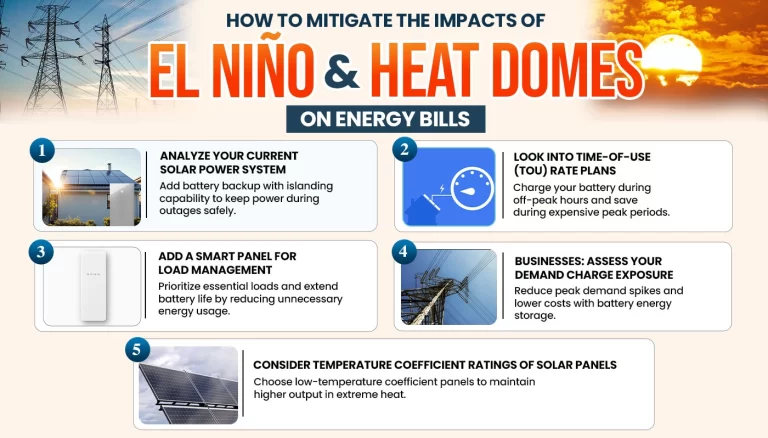
How to mitigate the impacts of El Nino and heat domes on energy bills

Analyze Your Current Solar Power System:

Most people believe that owning solar power panels is all they need to survive an outage. That’s simply not true. If there is no battery backup available for your system, it will most probably shut off as soon as there’s an outage, as this is mandated by law because of safety issues. If you have panels without storage, contact a reliable solar installer about adding battery backup with islanding capability.

Consider Temperature Coefficient Ratings of Solar Panels:

When selecting solar panels, most people pay attention only to their wattage and price, but in hot states, temperature coefficient is important equally. It reflects the decline in power from each degree above the rated temperature of testing at 25°С. Most panels lose from 0.35 to 0.45% of their power per one degree, while more modern TOPCon and HJT panels lose around 0.25-0.30%. It becomes an important feature in case your roof gets up to 65-80°C during the heat dome. These types of panels have already been used in around 40% of residential market of USA in 2026.

Add a Smart Panel for Load Management:

Traditionally, homeowners had to choose between a whole-home battery backup or a critical load panel that powers only fixed circuits during a blackout. The limitation of this approach is that it doesn’t adapt to real-time energy needs.

A smart panel changes this completely. Unlike a traditional setup, it continuously monitors and manages your home’s electrical loads. During an outage, it intelligently prioritizes essential devices like refrigerators, medical equipment, Wi-Fi routers, and a selected cooling zone, while automatically shutting off non-critical loads such as pool pumps, dryers, or other high-energy appliances.

This dynamic load management helps extend battery life during blackouts by preventing unnecessary energy drain. It also improves the efficiency of solar energy usage by distributing power where it’s needed most.

For most homes, the combination of solar panels, battery storage, and a smart panel provides more reliable, flexible, and real-world protection than either a fixed critical-load system or a standard whole-home backup setup.

Look into Time-of-Use (TOU) Rate Plans:

Many utilities, especially in PJM states and other NERC-flagged regions now offer time-of-use pricing, where electricity costs significantly more during late afternoon and evening peak hours and considerably less overnight or in the early morning. Without a battery, this pricing structure mostly just penalizes you for normal evening routines like cooking dinner or running the AC after work. With a battery, particularly one coordinated through a smart panel, your system can automatically charge during the cheapest overnight hours and discharge during the most expensive peak window, shifting your consumption pattern without requiring you to change a single habit. Over a full summer, this kind of automated arbitrage can meaningfully reduce your total electricity costs, on top of whatever savings you’re already getting from solar generation itself. 

Businesses: Assess Your Demand Charge Exposure:

Commercial electricity bills work differently from residential ones. In addition to paying for total energy consumed, most businesses also pay a separate “demand charge” based on their single highest 15-minute usage spike during the billing period, even if that spike only happens once. This means a brief surge from equipment startup, a walk-in freezer cycling on, or an HVAC system kicking in during a heat wave can drive up your entire month’s bill, regardless of your average usage. A behind-the-meter battery system addresses this directly by automatically discharging during those spike moments, flattening your peak demand before it ever reaches the meter. In markets with high demand charges, this single function can reduce total commercial electricity costs by 20–30%, with most systems paying for themselves through those savings in under five years. 

Why a solar only system is not enough to fight back energy challenges in 2026?

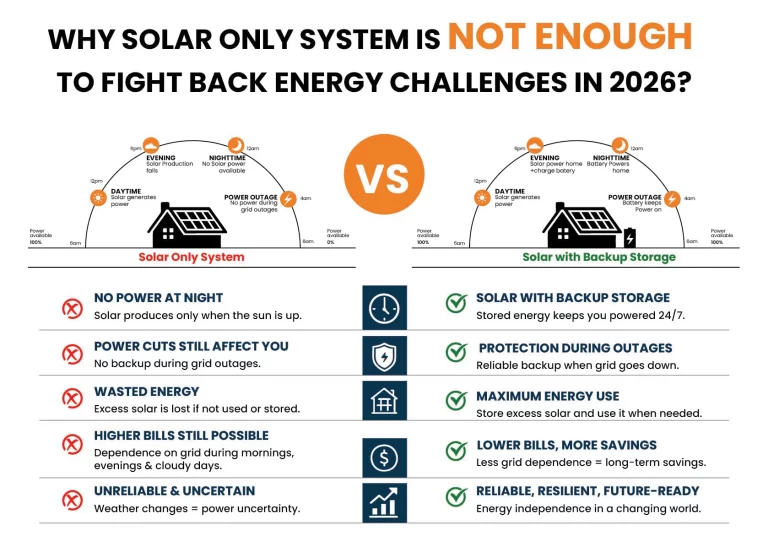
A solar-only system cannot fully meet the demands of today’s U.S. weather conditions and increasing grid outages. During heat domes, rooftop solar panels can reach temperatures up to 65°C, leading to as much as a 20% drop in efficiency exactly when electricity demand is highest. El Niño conditions further increase cooling needs, driving up air conditioning costs across many regions. However, without energy storage, homeowners cannot store low-cost daytime solar energy to offset expensive evening peak rates.

In addition, during grid failures, solar-only systems shut down due to anti-islanding safety rules, leaving homes without power even in extreme heat. During 2025 outages in Northeast, solar-only homes remained dependent on the grid.

A combined Solar PV + Battery system solves this problem by switching instantly during outages and continuing to power essential loads while solar recharges the battery.

solar only system vs solar with battery

NERC’s message for summer 2026 is clear: the grid is running leaner than it has in years, demand is outpacing supply in critical regions, and extreme weather from El Niño is poised to stress the system exactly when Americans can least afford it. 

For residents and businesses in PJM states, Texas, and the broader Southwest, this isn’t a distant theoretical risk. It’s a live operational concern backed by the country’s top grid reliability authority. Heat domes don’t just make you uncomfortable, they degrade your solar output, spike your bills, and strain the infrastructure that millions of homes depend on simultaneously.

Solar with battery storage is no longer a luxury or a green statement, it’s becoming foundational infrastructure for homes and businesses that want to stay powered, in control, and protected from a summer that’s shaping up to test everyone’s resilience.

Solar SME is a local solar installer near you, offering reliable solar and backup storage solutions with affordable solar financing plans. You can get a FREE Online Estimate with our smart solar calculator.

Check Your Solar Savings with our Smart Solar Calculator!

Start with a free tailored solar quote, compare brands and financing options, and explore your potential with zero obligation. 

Related Articles:

Rising utility prices and grid instability are changing how Americans power their homes. Explore why thousands of homeowners are investing in solar panels with battery storage to secure backup power, avoid peak electricity costs, and gain greater control over their household energy future.
Although solar panels are designed to withstand harsh weather conditions like storms, hurricanes, and hail, however, their power generation may significantly vary depending on the environment. Explore how weather impacts on your system performance.
Solar PV loss, like shading, dirt, temperature effects, electrical issues, etc., may impact the performance and output of your system. Learn about the top solar PV losses, their causes, their impacts and practical tips to minimize these issues.

Scroll to Top